
Everyone now makes apps. But you must know this.
(Presto Kaung didn’t wrote this with AI 😄) — AI has grown quite a lot, and big companies are giving it away for free. But app-generation is very different from photo/video generation.
My Girlfriend Made an App Faster Than I Did
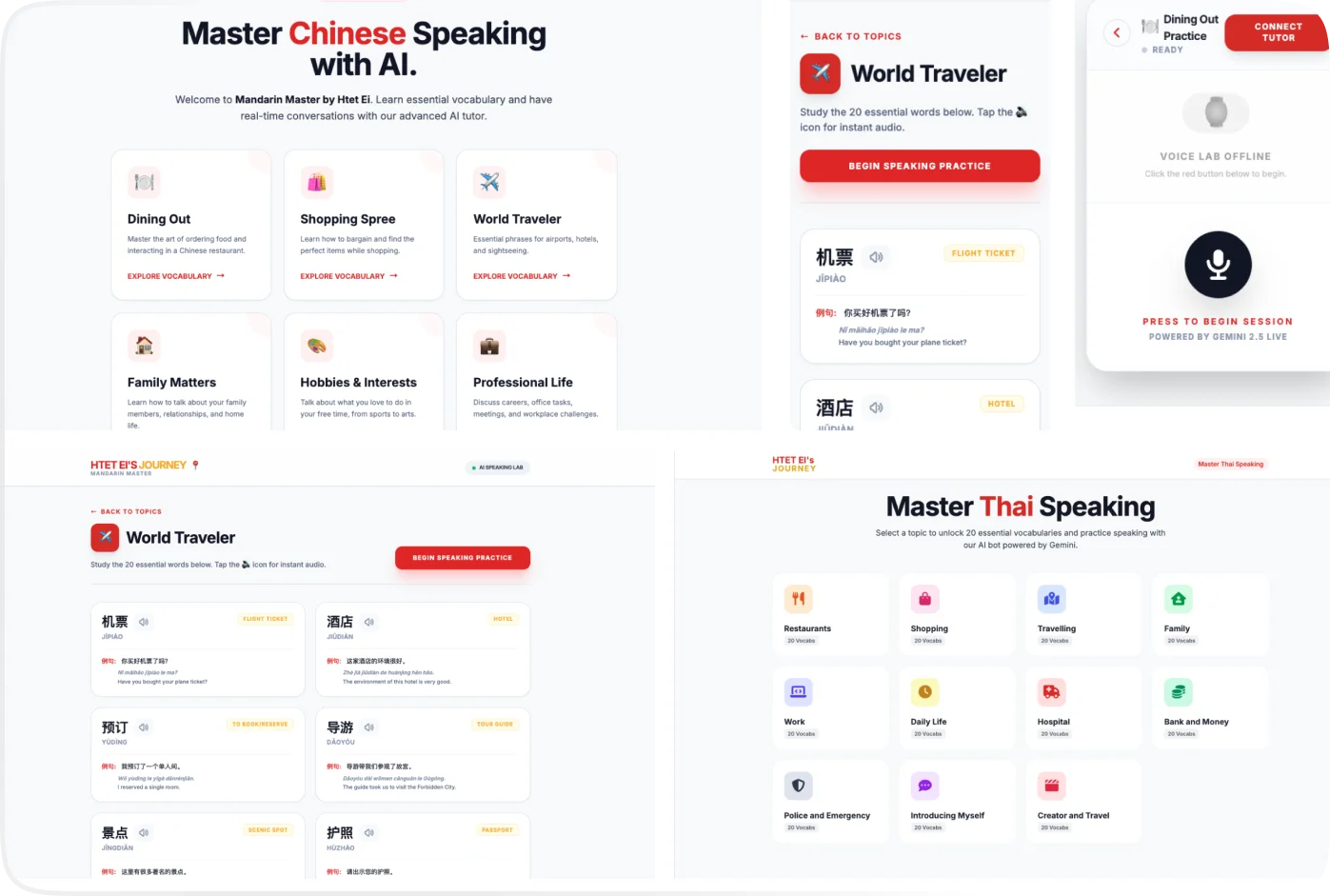
One morning in Jan 2026, I found my girlfriend practicing Chinese with what looked like an app. I later found out that she had built the app for herself.
I showed her how to use Google AI Studio last night. It didn’t even take her 12 hours to build and use it. On top of that, she created an AI conversational practice tool. Not just a normal app.
When I started, not even 10 years ago, there was no shortcut, no other way but grinding after grinding to get an ugly-looking app. It took me over 20 failures and a lot of learning in product design and programming to be able to build what I consider extremely quick MVP apps.
Yet, I was no match.
That Satisfying Feeling of Seeing Your First App
Drama aside, I have been seeing this trend all over my friends and family. AI has grown quite a lot, and big companies are giving it away for free. Free to consumers but clever enough to constantly search for ways to make money.
Everyone knows that AI is costly and time-consuming. But for someone who has always considered app-making to be beyond several barriers to reach, this is an extremely satisfying feeling.
Even for me, seeing an app I created is one of the most joyous moments every time.
This is not AI helping us. AI companies have simply found a deep desire and need in almost everyone.
One of your daily problems is solved by an app you just made in a few minutes, something you couldn’t even imagine a year before. I can totally relate to how cool it is, how proud and satisfying it feels. I would share it with others. They can also start to create, and domino effects will begin.
But there are a few problems.
App-Generation Is Different from Photo/Video Generation
We were able to create images and videos easily while they were still in “preview,” when companies pretended to be “generous.” As these companies learned we can’t live without these tools, a cost emerges, one that can’t be justified for something we are making just for “fun.”
Simply put, it is too expensive. Before AI tools, a $20 or $40 monthly subscription was already absurd let alone $200 a month.
For generating your app with AI, there is one more catch.
Once you generate an image or a video, you don’t need to keep paying to use it. Once it’s out, it’s yours forever.
Apps are different.
Yes, you can technically still use them. But sooner or later, they are bound to hit a wall.
What wall?
The Four Walls of AI Apps
Wall 1: Hidden Costs

Apps use multiple services to function — not just one. This might be an over-generalization, but let me explain.
Imagine you just opened a restaurant. You were given a place, some cool meals to sell, and a waiter to serve ready-made, all for free.
If there are only a few customers, you’re fine. As soon as you have more customers, you need to expand. But since you are using our space, our food, and our waiter, we now have special pricing for you if you want to continue.
Then you find out you could have cooked yourself, hired your own waiter, and opened the restaurant in your garage for much less. But your customers already know this place too well and they especially love your food.
Now you’ve hit a wall. That wall.
This is by no means an evil agenda or trick. It exists as a well-known business model and tactic in modern service providers. It’s just that people who are not from this world don’t have a clue about it.
Wall 2: Generated Apps Are Difficult to Scale

Let’s say that since everyone loves your app, there is a chance. So you pay for everything, continue, and start to scale it.
This leads to another big problem.
There is one thing app creators and programmers really hate: repairing (or rescuing) an app made out of bad code. By “bad,” I mean code that is not optimized, not easy to read, and not easy to fix when errors appear. There are techniques and practices to avoid this.
AI can read and write code at a god-level. Because of that, it doesn’t need to write code structurally for itself. If you don’t specifically mention it, AI will program in a way that is most efficient for it.
And then AI forgets.
As of right now, AI has a limit on how many things it can remember. This is the same problem as not being able to give a whole textbook’s worth of text to AI.
Imagine a clothing shop. Instead of storing and displaying items properly, customers ask a person, and he searches and picks clothes from a pile. He is really, really fast.
But soon, you open another six shops. The pile grows bigger than ever. This very fast guy now can’t remember everything and starts making serious mistakes.
We chose the piling-clothes approach because he was extremely fast.
Now he forgets. And that is the big problem with scaling AI apps.
As your app grows, you need to expand not only storage but also logic to run bigger tasks or more tasks at the same time.
What makes this worse is that if AI forgets and makes an error, it can create a cascading effect. Even AI will struggle to understand where the problem is.
When ChatGPT first launched, we could only send a limited number of words. No memory. No context. Now it can handle much more and it will keep getting better every year. But welcome to the big invoices.
(You can skip this if you are not into coding.)
Here are specific examples of what I mean by ‘bad code’:
- AI sometimes doesn’t do modularization at all. It writes everything in one file. On the other hand, it separates everything into classes and methods all the time, making it too hard to read.
- Even though AI knows what’s the latest, its ability comes from training on past coding methods, and it keeps using deprecated methods.
- Even with existing classes and constants, AI sometimes doesn’t care about them and chooses to code from scratch again. E.g., it neglects a few color constants and just uses hex codes as it sees fit. And it is difficult to notice it if you don’t double-check.
- AI’s current context window is not enough to handle complex logic. So unless a person is thinking through all the logic, AI will just make assumptions and do it anyway. And it pretends it did the best job in the world like a proud puppy.
- The worst-case scenario: AI sometimes takes a burn-it-all approach to fix a tiny bug. In fixing bugs and errors, it only focuses on fixing them at the cost of breaking down everything we have built. One time, it deleted and switched all my typography and colors. But the app still worked, and we didn’t notice it until it was too late.
Wall 3: The Time-Sink
Then there is the biggest problem of all.
One thing you will hear from anyone who has built a proper app with AI is this: it is time-consuming. It feels like you are sitting next to a brainless genius all the time.
Everyone wants to polish their app just a little bit. That “little bit” quickly turns into hours, then days.
My girlfriend stopped tweaking her app once she realized half of her day was spent on it, and she could no longer focus on her actual work. It was fun but not worth that much precious time.
One major culprit of this time sink is AI’s sudden slips and extremely foolish errors like extra fingers in AI-generated images.
Since non-programmers don’t know how code works or what things are called, going back and forth with AI to fix simple issues can take hours. In this sense, it becomes very counter-productive.
I have seen AI create logic that would have taken me more than two days in one minute. Then struggle for hours to fix an extremely simple error like a missing bracket.
In the worst-case scenario, AI uses a “burn all the houses to find the needle” approach. I have seen this happen several times in my own apps.
Time-consuming is an acceptable trade-off given what AI can help us achieve.
Wall 4: The Progress-Void
But the real effect of this problem becomes apparent over a longer time frame.
When we do something for a long time, we start noticing intricate details and gradually become very, very good at it. This happens over months and years. This is one of the reasons juniors eventually grow into seniors.
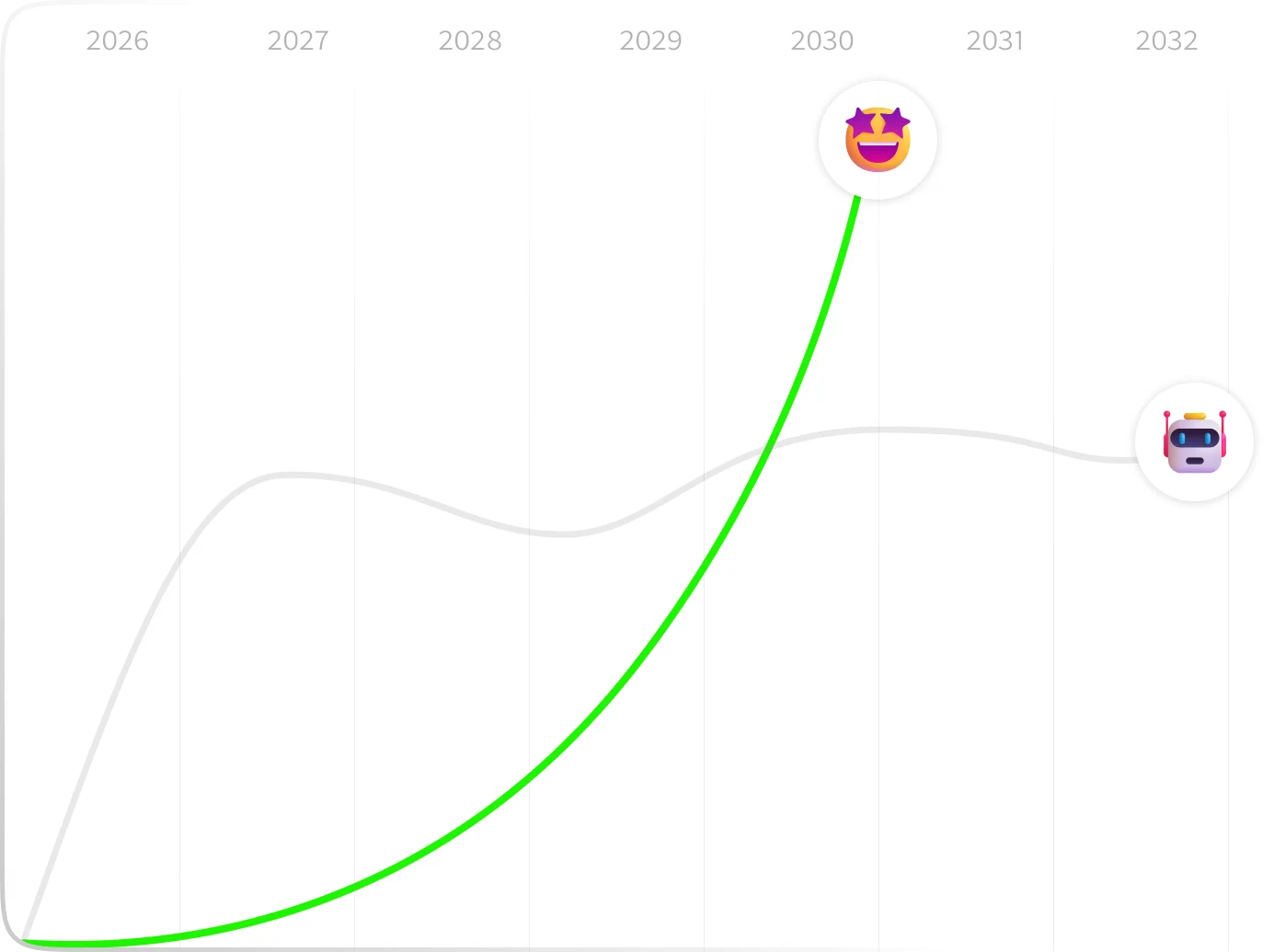
If you spend months talking to AI to build your app, you learn nothing except how to quarrel with AI over its sudden and costly hiccups.
You can replace a junior programmer with AI today. But in three years, you will get another AI, just more powerful.
That junior programmer, meanwhile, gains experience, sharpens skills, builds intuition, and becomes a partner who can support you with much more than just coding.
This “progress-void” nature of AI also affects us.
We become better prompters but we don’t learn how code works, how logic flows, or how to build intuition. People are intrinsically lazy when it comes to thinking. We prefer asking over understanding what AI actually did.
What happens if we stop thinking for five years?
It Is a Tool: Don't Be Lazy
AI is actually good and going to help us.
AI is really good. I repeat AI is very, very, very good.
It sped up my workflow by 70–80% and helped me do things I couldn’t even imagine before, like building a game.
What I am trying to say is simple.
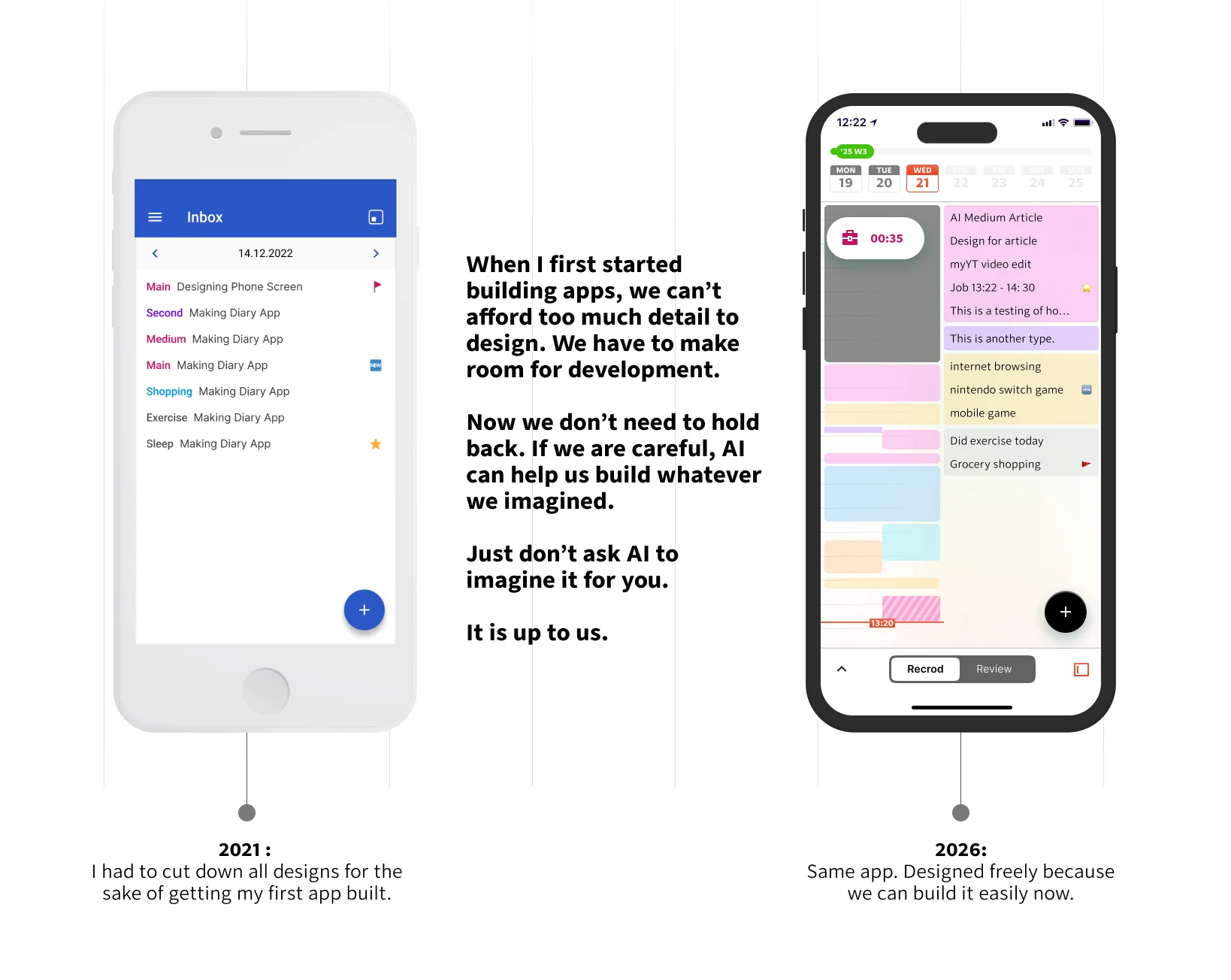
It is a tool
It is the same thing everyone is already talking about: AI is a better writer, a better planner, a better knowledge base, and a better builder. But it is still just a better tool.
We should not cloud ourselves with the speed and fun of using AI.
We must know when the fun stops and when things become real. At that point, we have to treat it as such — get clear on what we want to achieve, analyze the prospects, accept the learn–build–improve loop, plan accordingly, and build intentionally and patiently.
Don’t be lazy
In short, think harder and leave the manual labor to AI.
AI is not here for us to be lazy. It is here so we can focus on the one thing humans still do best: thinking.
Thinking remains the irreplaceable human craft.
Originally published on Medium (Design Bootcamp).
You might also like
 Sep 15, 2026
Why Custom Apps Cost More Than People Expect
Understanding the real costs behind building software: team salaries, the challenge of building alone, and why an app is an ongoing commitment.
 Sep 15, 2026
Mobile App vs. Web App: What Founders Need to Know
Understanding the real differences between an app you download from the store and an app that runs in your browser.
 Nov 27, 2023
We should try this for Health App Dashboards (Redesigning Withings App)
I am redesigning this for educational purpose. I saw Withings’ announcement in CES 2023, their products look so polished that I started checking their website and found the app.